10 Best Website Auditing Tools to Boost Your SEO in 2026
Website auditing tools act like a diagnostic scan for your site, exposing hidden issues that can drag down rankings before they turn expensive. Whether you’re an SEO expert, entrepreneur, or developer, choosing the right tool can decide if you rank on page one or disappear online.

Your website might look beautiful — but if search engines can't crawl it properly, or if it loads slowly and has broken links, you're leaving traffic and revenue on the table. Website auditing tools give you an X-ray view of your site's health, revealing issues that hurt your rankings before they become costly problems. Whether you're an SEO professional, a small business owner, or a developer, the right audit tool can be the difference between page one and page oblivion.
Here are ten of the best website auditing tools available today — covering technical SEO, performance, on-page analysis, and more.
1. SEOZilla
Freemium
seozilla.ai →
SEOZilla is a modern, AI-powered auditing platform built for speed and clarity. It scans your entire site for technical issues, on-page SEO weaknesses, and content gaps — then presents results in a clean, prioritized dashboard. What sets SEOZilla apart is its actionable scoring system: every issue comes with an explanation and a step-by-step fix, making it ideal for marketers who don't want to wade through raw data. Its AI recommendations are particularly useful for identifying quick wins versus long-term structural changes.
2. SEOptimer
Freemium
seoptimer.com →
SEOptimer delivers a fast, no-fuss website audit in seconds. It checks over 100 SEO factors — including meta tags, social media integration, mobile-friendliness, and page speed — and gives your site an overall letter grade. It's perfect for freelancers and agencies who need to quickly demonstrate SEO value to clients. The embeddable audit widget is a standout feature, letting you add a branded audit form to your own website to generate leads.
3. Ubersuggest / Neil Patel SEO Analyzer
Freemium
app.neilpatel.com → SEO Analyzer
Neil Patel's SEO Analyzer, part of the Ubersuggest suite, offers a comprehensive site audit that goes beyond basic checks. It surfaces critical errors, warnings, and recommendations across crawlability, site speed, backlinks, and keyword opportunities — all within a single dashboard. The tool excels at competitor analysis, letting you benchmark your SEO health against rivals. A generous free tier makes it accessible for solopreneurs and small businesses just getting started with SEO audits.
What should a website audit cover?
- Technical SEO — crawlability, indexation, broken links, redirects, and XML sitemaps
- On-page SEO — meta titles, descriptions, heading structure, and keyword usage
- Page speed — Core Web Vitals, image optimization, server response times
- Mobile-friendliness — responsive design, tap targets, and viewport settings
- Backlink profile — toxic links, anchor text distribution, and domain authority
- Security — HTTPS implementation, mixed content warnings, and SSL certificates
4. Semrush Site Audit
Semrush Site Audit is the gold standard for enterprise-level website analysis. It crawls up to tens of thousands of pages and checks over 140 technical and on-page SEO issues — from duplicate content and hreflang errors to Core Web Vitals and internal linking problems. The thematic reports make it easy to focus on specific areas like crawlability or HTTPS implementation. When integrated with Semrush's broader toolkit, it becomes a powerhouse for tracking SEO progress over time.
5. AIOSEO SEO Analyzer
All in One SEO's free online analyzer is a straightforward tool tailored especially for WordPress site owners, though it works for any website. It checks fundamental on-page factors like title tags, meta descriptions, social sharing tags, and keyword usage. Because AIOSEO is one of the most popular WordPress SEO plugins, its analyzer integrates naturally with the plugin ecosystem, giving WordPress users a seamless audit-to-fix pipeline. It's best suited for site owners who want a quick health check without overwhelming complexity.
6. Rank Math SEO Analyzer
Free
rankmath.com/tools/seo-analyzer →
Rank Math's online SEO analyzer offers a clean, instant audit that checks on-page factors, technical basics, and usability signals. Like AIOSEO, it's closely associated with a WordPress plugin, making it particularly valuable for WordPress users looking to audit external competitor pages. It provides an overall SEO score along with color-coded pass/fail indicators for individual checks, making it beginner-friendly without sacrificing detail. The tool is entirely free with no sign-up required.
7. GTmetrix
Freemium
gtmetrix.com →
GTmetrix is the definitive tool for website performance auditing. While other tools offer speed checks as one of many features, GTmetrix focuses entirely on page load performance — measuring Core Web Vitals (LCP, CLS, FID), waterfall charts of every resource loaded, and detailed recommendations for improvements. You can test from multiple global server locations and simulate different connection speeds. For developers optimizing load times, GTmetrix is indispensable. Slow pages mean high bounce rates and lower rankings, and GTmetrix helps you pinpoint exactly what's causing the drag.
8. WooRank
Freemium
woorank.com →
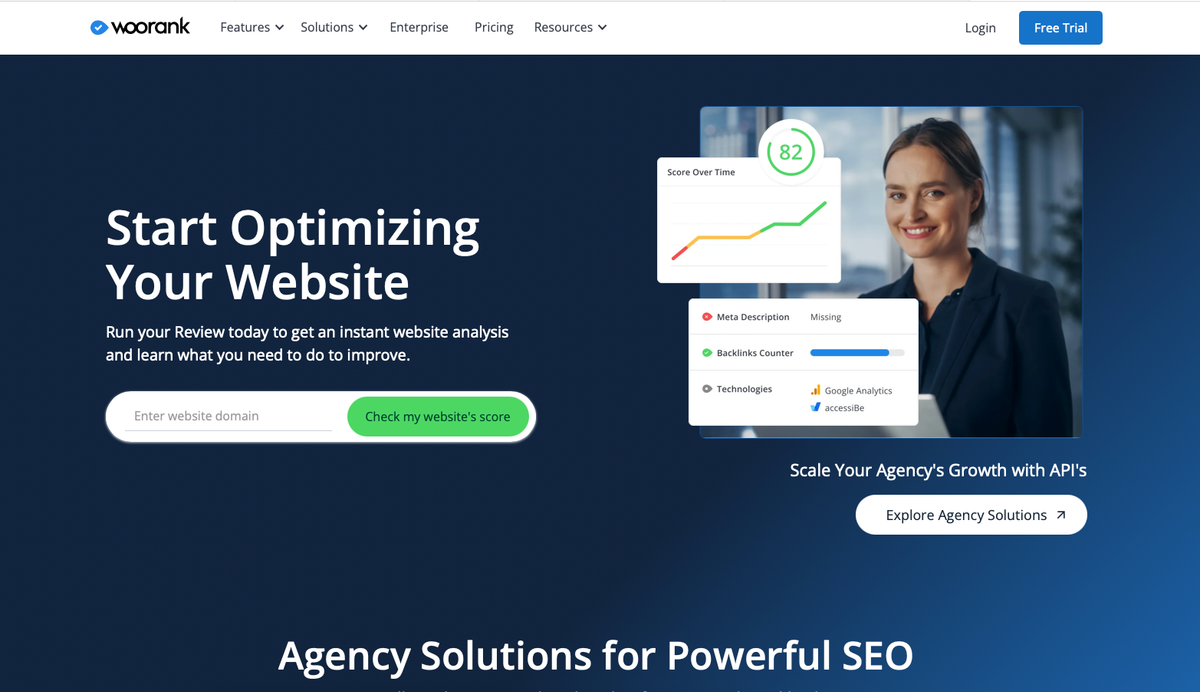
WooRank provides one of the most visually polished and comprehensive website review reports available. Its instant analysis covers SEO, mobile usability, structured data, social engagement, backlinks, and local SEO — all presented in a beautifully laid-out PDF-ready report. For agencies, the white-label reporting feature is a significant time-saver. WooRank also offers keyword tracking and competitor monitoring, making it a solid all-in-one platform for digital marketing professionals who need to report regularly to clients.
9. Google Search Console
Free
search.google.com/search-console →
No list of auditing tools is complete without Google's own free platform. Search Console is the authoritative source of data on how Google sees your site — surfacing crawl errors, manual actions, Core Web Vitals data directly from Google's index, and search performance metrics. It won't replace a full-featured third-party audit tool, but it's the foundational layer every website owner should have configured. Use it alongside any of the tools above to validate findings directly against Google's perspective.
10. Screaming Frog SEO Spider
Freemium
screamingfrog.co.uk/seo-spider →
Screaming Frog is the crawler of choice for technical SEO specialists. Unlike browser-based tools, it's a desktop application that mimics how search engine bots crawl your site — giving you granular data on every URL, response code, meta tag, heading, canonical tag, and internal link across thousands of pages. The free version crawls up to 500 URLs; the paid version removes all limits and integrates with Google Analytics and Search Console. If you do serious technical SEO work, Screaming Frog is non-negotiable.
Which Tool Is Right for You?
The best website auditing tool depends on your needs. If you're a beginner or small business owner, start with a free tool like SEOZilla, Rank Math's Analyzer, or Google Search Console. Agencies and professionals doing regular client reporting will get the most value from Semrush or WooRank. If page speed is your primary concern, run every page through GTmetrix. And for deep technical crawls on large sites, Screaming Frog remains unmatched.
The smartest approach? Use a combination — a comprehensive SEO platform like Semrush or SEOZilla for ongoing monitoring, GTmetrix for performance deep-dives, and Google Search Console as your baseline truth.
Regular auditing isn't a one-time task — it's an ongoing practice. Sites change, algorithms update, and new issues emerge. Schedule audits quarterly at minimum, and you'll stay ahead of the problems that quietly kill organic traffic.