The Open Museum of Eastern Nepal
THE LIVING MUSEUM OF EASTERN NEPAL
Where mountains, memory and indigenous cultures turn an entire province into a journey through living heritage.
By Arjun Uprety
A visitor arrives in the eastern hills of Nepal before sunrise.There is no ticket counter. No glass cabinet. No silent museum corridor.
Instead, there is an old house with a wooden doorway. A family is preparing breakfast. Somewhere nearby, the deep rhythm of a Chyabrung drum begins to rise. An elderly villager speaks of Mundhum, the ancestral oral tradition. Young people gather for a traditional dance.
The visitor eats with the family, listens to stories, learns a few unfamiliar words and watches a way of life that has survived across generations.The next morning, the journey moves through the tea gardens of Ilam.
Later comes a Lepcha settlement.
Farther north, the landscape changes again. The roads climb towards the Himalayas, where Sherpa villages, Buddhist monasteries, mani walls and prayer flags reveal another chapter of eastern Nepal's cultural story.By the end of the journey, there may be no artefact to carry home. But there is a story.And that story is the museum.
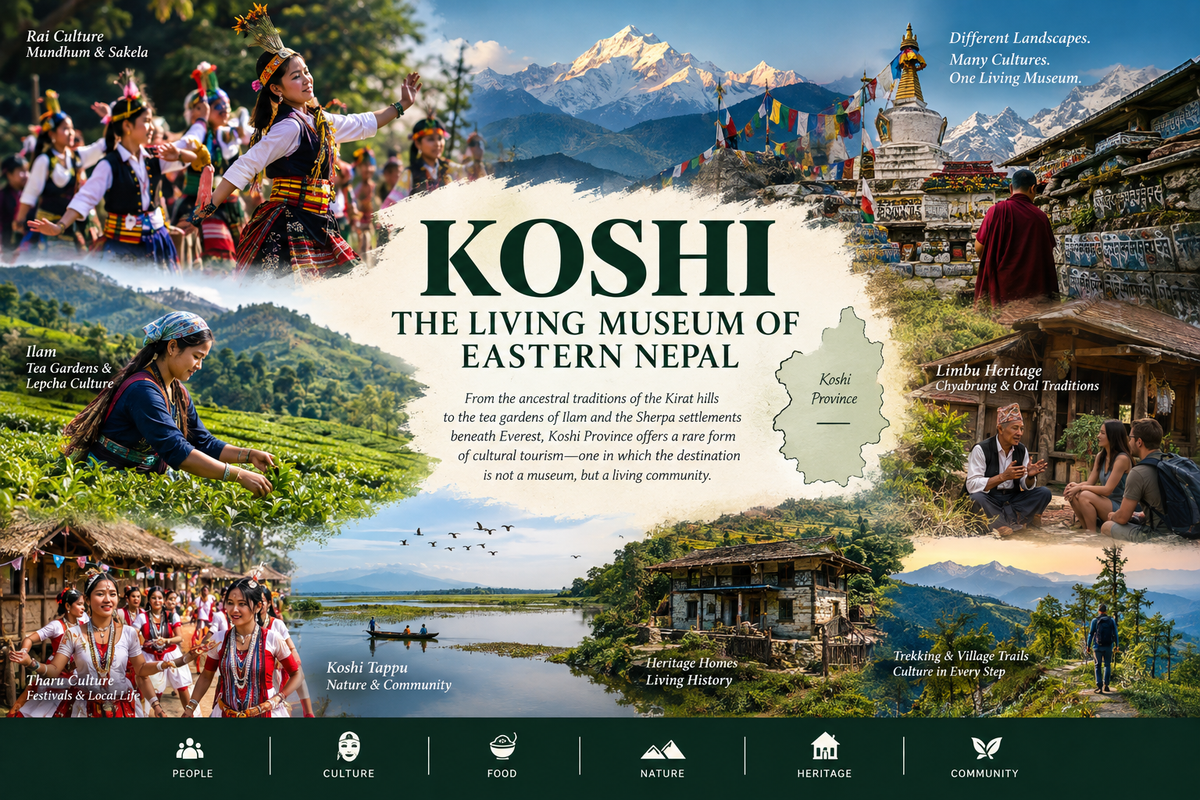
WHEN THE MUSEUM HAS NO WALLS Koshi Province stretches from the subtropical plains of southern Nepal to some of the world's highest mountains. It is officially divided into 14 districts. But geography tells only half the story. Across this vast landscape live communities whose languages, festivals, music, food, architecture, beliefs, agricultural practices and oral traditions create a cultural mosaic unlike almost anywhere else in Nepal.
Rai communities preserve Mundhum and Sakela traditions. Limbu communities maintain Mundhum, Chyabrung, Dhan Nach and Chasok Tangnam. Lepcha communities carry their own distinctive cultural heritage. Sherpa communities continue centuries-old Himalayan traditions.
In the southern plains, Rajbanshi, Dhimal, Meche, Santhal, Tharu, Tajpuriya and other communities add different layers to the province's cultural landscape. The result is something larger than a collection of museums. It is a living cultural landscape.
The museum is not necessarily a building. Sometimes, the museum is the village itself. A PROVINCE OF MANY CULTURAL WORLDS Koshi's cultural diversity changes with the landscape. In the plains of Jhapa, Morang and Sunsari, traditional food, agriculture, architecture, music and community institutions tell stories of long-established societies.
In the middle hills, the cultural landscapes of Rai, Limbu, Athpahariya, Yakha, Sunuwar, Magar, Gurung and Tamang communities create a different world. Higher still, the Himalayan environment introduces Sherpa, Lhomi and other mountain cultures. For travellers, this creates a remarkable possibility. Instead of visiting one museum and seeing fragments of the past, they can travel through the landscape where those traditions are still alive. An old house can become a heritage stop.A village elder can become an oral historian. A traditional meal can become a cultural experience. A festival can become a living exhibition. A farming system can become an interactive lesson. A musical instrument can become a performance. And a local trail can become a journey through centuries of memory.
RAI COUNTRY: FROM MUNDHUM TO SAKELA The hills of Bhojpur, Khotang, Okhaldhunga, Solukhumbu, Udayapur, Sankhuwasabha and Dhankuta contain important Rai cultural landscapes.
But “Rai” is not a single cultural identity in the simple sense. Bantawa, Chamling, Kulung, Khaling, Thulung, Sampang, Nachhiring, Bahing, Athpahariya, Mewahang, Yamphu and Lohorung are among the groups that contribute to the diversity of Rai heritage. At its heart is Mundhum—an oral tradition connected with ancestors, nature, social relationships and ideas about existence.
Then comes Sakela. The dance is more than movement. Ubhauli and Udhauli are more than festivals.They connect community, agriculture, nature and ancestral memory. Imagine arriving in a village in Bhojpur or Khotang. You enter an old house. You see agricultural tools and traditional instruments. You hear stories of ancestors. Then the rhythm of Sakela begins. The visitor is invited into the circle. This is no longer cultural observation. It is cultural participation.
That is the difference between seeing a culture and experiencing it. LIMBU HERITAGE: THE RHYTHM OF CHYABRUNG Across Taplejung, Panchthar, Tehrathum, Ilam and Dhankuta and into parts of the southern plains the Limbu cultural landscape forms another major chapter of Koshi's heritage.
Mundhum, the Sirijanga script, Chyabrung, Dhan Nach and Chasok Tangnam provide windows into this culture. For tourism, the opportunity lies not simply in staging performances. Visitors can learn why a festival is celebrated. They can taste traditional food. They can listen to oral histories.
They can learn the rhythm of the Chyabrung. They can stay in traditional houses.They can walk through settlements where cultural practices remain part of everyday life. A cultural trail linking traditional homes, local food, handicrafts, oral history and community festivals could create a different kind of tourism experience. One measured not by how many monuments a visitor sees but by how deeply the visitor connects with a place.
ILAM: BEYOND THE TEA GARDENS Few landscapes in Nepal are as immediately recognisable as Ilam. Green hills. Rolling tea gardens. Misty mornings. Kanyam.Antu. But the story of Ilam does not end with tea.The Lepcha heritage of the region offers another cultural dimension. Language, traditional houses, food, indigenous knowledge, beliefs and oral histories can become part of a cultural tourism experience. Imagine beginning the morning among tea bushes, learning how leaves are picked. By afternoon, the landscape changes. A Lepcha settlement.A traditional meal. An elder telling stories.
Local music at sunset. A homestay at night. The next morning, another journey begins. Tea becomes the gateway. Culture becomes the destination. THE PLAINS: RAJBANSHI, DHIMAL, MECHE AND SANTHAL WORLDS Koshi's cultural story is not confined to the hills. The plains of Jhapa and Morang contain communities whose heritage is deeply connected with agriculture, forests, rivers and settlement patterns.
Rajbanshi, Dhimal, Meche, Santhal and Tajpuriya communities possess distinctive traditions expressed through language, architecture, food, music, dance, agricultural practices and social institutions. A cultural village could allow visitors to experience these traditions directly. A traditional house. A local kitchen. An agricultural field. A folk performance. A craft demonstration.
An oral-history session. Instead of turning culture into a stage show, the emphasis would remain on community life. The visitor becomes a guest rather than an audience member.
SUNSARI: WHERE CULTURE MEETS THE KOSHI RIVER In Sunsari, cultural tourism can meet nature tourism. Tharu communities preserve traditions expressed through festivals such as Maghi and Jitiya, local food, music, dance, agricultural practices and traditional architecture. Nearby, the landscape around Koshi Tappu offers a powerful natural setting. A carefully designed itinerary could connect wildlife and culture:
Koshi Tappu → Tharu village → traditional food → heritage house → folk dance → agricultural experience
For visitors arriving to see wildlife, this creates another reason to stay longer. The river becomes more than a landscape. It becomes part of a human story.
DHANKUTA AND TEHRATHUM: HISTORY BEHIND OLD DOORS A museum does not always require a new building. Sometimes, an old house is enough. Its wooden structure. Its rooms.
Its kitchen. Its agricultural tools. Its family history. Its stories.
In Dhankuta and Tehrathum, traditional houses and cultural practices can become part of heritage trails.Visitors could sleep in restored traditional houses, eat local food and hear the history of the families who built them.Such places would not simply offer accommodation. They would offer a night inside history.
BHOJPUR AND KHOTANG: AN OPEN CLASSROOM OF KIRAT CIVILISATION Bhojpur and Khotang offer important landscapes for understanding Kirat civilisation and cultural traditions.
Mundhum, Sakela, traditional houses, agriculture, music, handicrafts and oral history could form the foundation of a Kirat cultural trail. Historic sites and cultural museums could become gateways rather than destinations in themselves. The visitor could leave the museum building and walk into the community where the story continues. That is the essence of open-air cultural tourism.
SANKHUWASABHA: WHERE THE HILLS MEET THE HIMALAYAS Sankhuwasabha occupies a remarkable cultural and geographical position. Yakha and Lhomi traditions exist within a landscape that rises towards the high Himalayas and the Makalu region. Language, clothing, food, architecture, beliefs and indigenous knowledge can become part of a broader cultural experience. For trekkers heading towards Makalu, the journey could offer more than mountains. It could offer encounters with communities whose lives are shaped by the same landscape. Adventure becomes more meaningful when the traveller understands the people behind the landscape.
SOLUKHUMBU: WHERE THE HIMALAYAS HAVE A HUMAN FACE For much of the world, Solukhumbu means Everest. For the people who live there, it means home. Sherpa villages, monasteries, mani walls, prayer flags, traditional houses and religious practices form a cultural landscape as remarkable as the mountains themselves.
Namche, Khumjung, Khunde, Thame and other settlements offer opportunities to experience Himalayan life beyond the trekking trail. Visitors can enter monasteries. Share meals with local families. Learn about Sherpa history. Listen to local stories. Observe traditional architecture.
And understand how communities have adapted to life in one of the world's most demanding environments. Everest may bring the traveller to Solukhumbu. Sherpa culture can make the traveller stay.
TAPLEJUNG: THE PEOPLE BENEATH KANCHENJUNGA Taplejung is internationally associated with Kanchenjunga. But the journey towards the world's third-highest mountain passes through communities whose cultural heritage deserves equal attention. Limbu settlements, Mundhum-related sites, traditional houses, Chyabrung, local food, agriculture and oral history can become part of the Kanchenjunga experience. The result could be a longer and richer journey.
Not simply: Mountain → Trek → Return But:Community → Culture → Food → Landscape → Trek → Mountain The idea is simple. Do not only show travellers the mountain. Introduce them to the people who live beneath it. FROM HERITAGE TO A LOCAL ECONOMY Living museum tourism is not simply about cultural preservation. It can also become a local economic model.
A visitor staying in a homestay supports a family. A traditional meal supports local farmers.
A local guide earns income. A handicraft purchase supports traditional skills. A cultural performance creates value for artists. A longer stay benefits transport operators, shops and other local businesses.The economic model therefore moves beyond the conventional tourist centre.
Instead of concentrating tourism revenue in a few hotels and businesses, living cultural tourism can distribute income across communities.The village becomes the destination and the community becomes part of the tourism economy.
THE DELICATE LINE: WHEN CULTURE BECOMES A PRODUCT There is, however, a danger.When culture enters the tourism market, it can become a performance created solely for outsiders. That must be avoided. Communities should retain ownership of their cultural knowledge.
Traditional practices should not be altered simply to satisfy visitors. Local people should participate in tourism decisions. Tourism revenue should benefit the communities whose heritage attracts visitors.Oral histories should be documented responsibly.
Traditional houses should be conserved rather than stripped of their character. Most importantly, cultural tourism should not be about selling identity.It should be about creating respectful encounters between people. THE KOSHI LIVING MUSEUM Perhaps the most ambitious idea for Koshi is not to build one giant museum. It is to connect many small living museums. A village can be a museum. An old house can be an exhibition space.A language can be a living archive. A folk song can become an audio collection. A dance can become a living performance. A festival can become a cultural calendar. Traditional food can become culinary heritage. Agriculture can become an experiential activity. A monastery can become a spiritual heritage site. And an elderly storyteller can become a living historical archive. This would create a museum without walls. A museum that moves. A museum that breathes. A museum that belongs to the people who created it.THE NEXT CHAPTER OF KOSHI TOURISM Koshi already possesses many of the ingredients required to become one of Nepal's most distinctive cultural tourism destinations. It has mountains.Rivers.Tea gardens. Forests. Trekking routes. Historic settlements. Traditional architecture. And extraordinary cultural diversity. But its most important tourism resource may be less visible. It is the people. Their languages. Their memories.Their festivals. Their food.Their music. Their houses.Their stories.Their relationship with the land. For decades, tourism has often been built around the idea of seeing. Koshi has an opportunity to build something different around the idea of experiencing. A visitor may arrive to see Everest. Another may come for tea. Someone else may come for trekking. But the most memorable journey may be the one that leads into a village, around a family table and into a story passed down through generations. At that moment, the traveller is no longer simply a tourist.
The traveller has become a temporary participant in another cultural world. And when the journey ends, there may be no artefact to take home. Only a memory. Only a story. Only the feeling of having encountered something that cannot be placed behind glass. Because in Koshi, the greatest museum may not be a building at all. It may be the living landscape itself.