What is a Learning Curve? Understanding Progress and Mastery

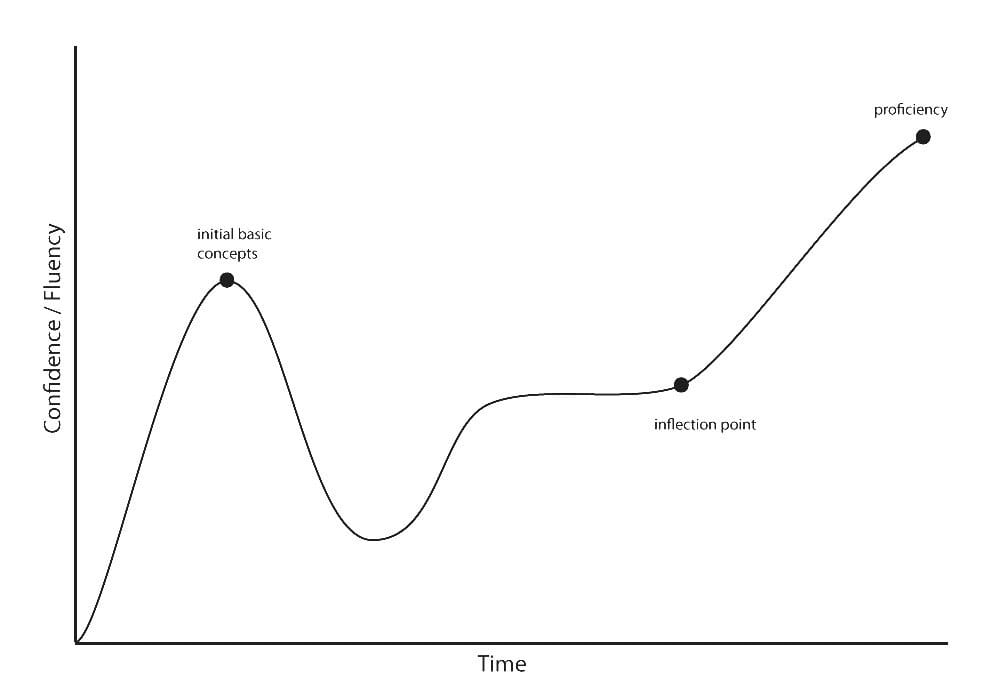
You've probably heard someone say "it has a steep learning curve" when describing a challenging new skill or software. But what does that really mean? And why does the phrase sometimes seem to be used in contradictory ways?
The learning curve is one of the most misunderstood concepts in both everyday conversation and professional contexts. Understanding what it actually means—and how it applies to your own learning journey—can help you set realistic expectations, measure progress, and persist through the challenging phases of acquiring new skills.
The Basic Definition
A learning curve is a graphical representation that shows the relationship between experience (or practice) and proficiency over time. In its simplest form, it's a line on a graph where:
- The horizontal axis (x-axis) represents time, practice, or experience
- The vertical axis (y-axis) represents performance, skill level, or productivity
The curve shows how quickly someone gains competence in a new skill or task. It visualizes the rate of improvement as learning progresses.
The Origin: Where Learning Curves Come From
The concept originated in manufacturing and industrial psychology in the early 20th century. In 1936, Theodore Wright published research showing that aircraft production time decreased predictably as workers gained experience. Each time cumulative production doubled, the time required to build a plane decreased by a consistent percentage.
This pattern—improved performance with repeated practice—appeared across various industries and tasks, leading to the formalization of the learning curve concept.
While it started in manufacturing, the learning curve now applies to virtually any skill acquisition: learning an instrument, mastering software, speaking a new language, developing athletic abilities, or gaining professional expertise.
Types of Learning Curves
Not all learning curves are created equal. Different skills and contexts produce different curve shapes, each with distinct characteristics.
1. The Classic S-Curve (Most Common)
This is the most typical learning pattern and has three distinct phases:
Phase 1: Slow Start (Bottom of the S)
When you first begin learning something new, progress feels slow. Everything is unfamiliar, you're building foundational knowledge, and you make frequent mistakes. This initial phase can be frustrating because the effort invested seems disproportionate to the results.
Phase 2: Rapid Improvement (Middle of the S)
Once you grasp the basics, progress accelerates dramatically. Concepts start connecting, patterns become recognizable, and skills compound on each other. This is the most rewarding phase—you can feel yourself improving noticeably day by day.
Phase 3: Plateau (Top of the S)
Eventually, the rate of improvement slows. You've reached a level of competence where further gains require increasingly more effort. This doesn't mean you've stopped learning, but the improvements become more subtle and incremental.
Examples: Learning a musical instrument, acquiring a new language, developing athletic skills
2. The Steep Learning Curve
Despite common usage, a "steep" learning curve technically means rapid improvement—the y-axis (performance) increases quickly relative to the x-axis (time). However, in everyday language, people often use "steep learning curve" to mean "difficult to learn," which actually refers to a curve that starts low and rises slowly.
What people usually mean: High initial difficulty, slow early progress
What it technically means: Rapid skill acquisition
This confusion happens because people focus on the difficulty of the climb rather than the rate of improvement.
Examples of actually steep curves: Learning to ride a bike (difficult at first, then sudden competence), using basic features of new software
3. The Diminishing Returns Curve
This curve shows rapid initial progress that gradually slows over time. Early gains come easily, but reaching higher levels of mastery requires exponentially more effort.
Examples: Improving athletic performance times, mastering chess at advanced levels, optimizing code performance
4. The Plateau-Breakthrough Pattern
Some skills show periods of apparent stagnation (plateaus) followed by sudden jumps in ability (breakthroughs). During plateaus, learning continues beneath the surface—your brain is integrating information—even though performance metrics don't improve.
Examples: Problem-solving abilities, creative skills, complex strategic thinking
5. The Long Tail Curve
In some areas, you can achieve basic competence relatively quickly, but true mastery takes years or decades. The curve rises quickly at first, then flattens into a very long, gradual slope.
Examples: Medical expertise, master craftsmanship, professional-level sports
Factors That Affect Learning Curves
Why do some people progress faster than others? Several factors influence the shape and slope of individual learning curves:
Prior Knowledge and Experience
Transfer of learning: Skills from one domain often accelerate learning in related domains. If you already know one programming language, learning a second is faster because core concepts transfer.
Foundation matters: Strong fundamentals in prerequisite skills create steeper learning curves for advanced topics.
Quality of Practice
Deliberate practice: Focused, intentional practice with immediate feedback produces steeper curves than mindless repetition.
Proper technique: Learning correct methods from the start prevents having to unlearn bad habits later.
Teaching Methods and Resources
Structured learning: Well-designed curricula and quality instruction accelerate progress.
Feedback loops: Quick, accurate feedback on performance helps learners adjust and improve faster.
Motivation and Mindset
Intrinsic motivation: People learning something they genuinely care about typically progress faster.
Growth mindset: Believing abilities can be developed through effort (versus being fixed) influences persistence through difficult phases.
Inherent Task Complexity
Cognitive load: Some skills simply require more mental processing, creating naturally slower curves.
Number of sub-skills: Complex skills composed of many components take longer to master.
Environmental Factors
Time availability: More frequent, consistent practice accelerates learning.
Support systems: Access to mentors, communities, and resources affects learning speed.
Common Misconceptions About Learning Curves
Misconception 1: "Steep = Difficult"
As mentioned earlier, people often use "steep learning curve" to mean "hard to learn." Technically, a steep curve indicates rapid improvement. The confusion likely comes from imagining the curve as a hill you must climb—steeper feels harder.
Misconception 2: Linear Progress
Many people expect steady, consistent improvement. In reality, learning is rarely linear. You'll experience spurts of rapid progress, frustrating plateaus, occasional regressions, and breakthrough moments.
Misconception 3: Reaching the Top Means Done
Learning curves don't have a definitive endpoint for most skills. Even experts continue learning, though improvements become more subtle. The plateau doesn't mean you've learned everything—it means you've reached a level where further gains require different approaches or more specialized practice.
Misconception 4: Everyone's Curve Is the Same
Learning curves are highly individual. Your pace of progress will differ from others based on prior knowledge, learning style, available practice time, quality of instruction, and numerous other factors.
Misconception 5: You Must Power Through Every Plateau
Sometimes plateaus indicate you need to change your approach, not just work harder. Seeking different resources, adjusting practice methods, or taking a brief break can be more effective than grinding through.
Practical Applications: Using Learning Curves in Real Life
Understanding learning curves isn't just theoretical—it has practical implications for how you approach learning anything.
Setting Realistic Expectations
Early frustration is normal: Knowing that most skills start with a slow phase helps you persist through initial difficulties without questioning your ability.
Progress isn't constant: Expect fluctuations. Some weeks you'll improve noticeably; others you'll feel stuck. Both are normal parts of the process.
Mastery takes time: Understanding the long-tail nature of expertise helps you commit to long-term development rather than expecting quick mastery.
Measuring Progress Effectively
Track multiple metrics: Performance, consistency, confidence, and understanding all matter. Sometimes one improves while another plateaus.
Look backward, not just forward: Compare yourself to where you were months ago, not just to where you want to be.
Recognize different types of progress: Understanding deepens even when performance plateaus. You might not solve problems faster, but you understand them more thoroughly.
Optimizing Your Learning
Identify your current phase: Different phases require different approaches. Early learning needs exposure to basics; plateau phases need varied practice or increased challenge.
Adjust practice methods: If progress stalls, experiment with different learning approaches, seek feedback, or increase difficulty level.
Embrace productive struggle: The learning curve is steepest just beyond your comfort zone. Too easy means slow progress; too hard means frustration. Find the sweet spot.
Managing Motivation
Celebrate early wins: Even small improvements matter, especially in the slow initial phase.
Prepare for plateaus: Knowing they're coming helps you persist through them without losing motivation.
Focus on process, not just outcomes: Consistent practice matters more than intermittent bursts based on motivation.
Learning Curves in Different Contexts
Professional Development
New job or role: Expect 3-6 months before you feel competent, 12-18 months before you feel truly proficient. Organizations that understand this invest in onboarding and mentorship.
New software or tools: Initial learning phase is typically 2-4 weeks for basic competence, 2-3 months for comfortable proficiency.
Education
Subject mastery: Foundational subjects show slower initial curves but enable steeper curves in advanced topics.
Skill-based vs. knowledge-based: Skills (writing, problem-solving) often show longer curves than knowledge acquisition (memorizing facts).
Hobbies and Personal Growth
Physical skills: Often show rapid initial progress (beginner gains) followed by long plateaus requiring consistent practice.
Creative pursuits: Frequently display plateau-breakthrough patterns as technique develops and artistic vision matures.
Technology Adoption
User interfaces: Well-designed products create steep learning curves—you become proficient quickly. Poorly designed ones have shallow curves or high initial barriers.
Complex systems: Enterprise software often has long learning curves because it requires understanding both the tool and the domain it serves.
The 80/20 Rule and Learning Curves
The Pareto Principle—that 80% of results come from 20% of effort—applies powerfully to learning curves. For most skills:
- You can achieve basic competence relatively quickly
- The fundamentals that cover most use cases represent a small portion of total possible knowledge
- Reaching expert level requires vastly more time than reaching competence
Practical implication: For many purposes, you don't need to fully master a skill. Identify what level you actually need and invest accordingly. Learning conversational Spanish requires far less time than achieving native fluency.
Overcoming Learning Curve Challenges
When Progress Feels Too Slow
Break it down: Divide the skill into smaller sub-skills with their own learning curves. Progress in components feels more achievable.
Find quick wins: Identify aspects you can improve quickly to maintain motivation while tackling harder elements.
Adjust expectations: Some skills genuinely require more time. Research typical learning timelines to gauge if your pace is normal.
When You Hit a Plateau
Change your practice: Do different exercises, approach the skill from new angles, or increase difficulty.
Seek expert feedback: Sometimes you can't see what's holding you back. An experienced mentor can identify blind spots.
Take a strategic break: Brief breaks allow consolidation and sometimes lead to breakthroughs when you return.
Be patient: Some plateaus represent integration periods where your brain is connecting concepts. Performance will catch up.
When You Want to Quit
Remember why you started: Reconnect with your original motivation.
Review your progress: Look at where you were at the beginning versus now. Progress exists even when it's not obvious.
Lower the bar temporarily: Instead of ambitious practice, just maintain the habit with easier sessions until motivation returns.
The Meta-Learning Curve: Learning How to Learn
Interestingly, there's a learning curve for learning itself. As you acquire multiple skills over your lifetime, you get better at:
- Identifying effective learning strategies
- Recognizing which phase of the curve you're in
- Persisting through difficult early stages
- Finding quality resources and mentors
- Practicing efficiently
- Managing motivation and mindset
Each skill you learn makes the next one easier—not because the content transfers, but because you've improved your learning process.
Conclusion: Embracing the Journey
The learning curve isn't just a graph in a textbook—it's a map of your growth journey. Understanding it helps you:
- Set realistic expectations about how learning actually works
- Persist through the inevitable difficult phases
- Recognize progress even when it's not obvious
- Adjust your approach based on where you are in the journey
- Appreciate that everyone's path looks different
Every expert was once a beginner facing a daunting learning curve. Every skill you've mastered started with that same frustrating initial phase where nothing made sense and progress felt impossible.
The curve isn't a barrier—it's a path. Yes, it has steep sections, frustrating plateaus, and moments where you question whether you'll ever improve. But it also has breakthrough moments, periods of rapid growth, and the deep satisfaction of competence earned through persistent effort.
Whatever you're learning right now, wherever you are on your curve, remember: every moment of practice, every small improvement, every mistake you learn from moves you forward. The shape of the curve matters less than the fact that you're on it, moving upward, growing.
Trust the process. Embrace the curve. Keep learning.