Vercel Serverless Functions: The Modern Way to Build Scalable Backends


In today’s fast-moving development ecosystem, developers want to ship faster without worrying about infrastructure management. That’s where Vercel Serverless Functions come in.
They allow you to build backend logic without managing servers, scaling configurations, or deployment pipelines. If you're building modern web applications — especially with Next.js — understanding Vercel Serverless Functions is essential.
Let’s break it down.
What Are Vercel Serverless Functions?
Vercel Serverless Functions are backend functions that execute on demand. Instead of running a traditional server 24/7, these functions:
- Run only when triggered
- Automatically scale based on traffic
- Shut down when not in use
- Require no server management
You write the function. Vercel handles the infrastructure.
This architecture is known as serverless computing.
How Serverless Functions Work
When a user sends a request to an API endpoint like:
https://yourdomain.com/api/contact
Vercel:
- Spins up a lightweight execution environment
- Runs your function
- Sends the response
- Terminates the environment when finished
No persistent server is running in the background.
Why Developers Love Serverless
1. No Server Management
No need to configure NGINX, PM2, or cloud servers. Deployment is Git-based.
2. Automatic Scaling
If 10 users visit your site, it scales for 10.
If 10,000 users visit, it scales instantly.
3. Cost Efficiency
You pay for execution time instead of paying for idle server time.
4. Global Edge Deployment
Functions run close to users worldwide, improving performance.
Example: Creating a Serverless API in Next.js
If you’re using Next.js, creating a serverless function is simple.
Create a file:
pages/api/hello.js
Add:
export default function handler(req, res) {
  res.status(200).json({ message: "Hello from Vercel Serverless!" });
}
After deployment, this becomes:
/api/hello
That’s your backend endpoint — live and scalable.
Common Use Cases
Vercel Serverless Functions are ideal for:
- Handling form submissions
- Sending transactional emails
- Connecting to databases (MongoDB, PostgreSQL)
- Payment integrations (Stripe)
- Authentication logic
- CRUD APIs
- Webhooks
Understanding Cold Starts
Because serverless functions don’t run continuously, there may be a slight delay when a function hasn’t been used recently. This delay is called a cold start.
Modern platforms like Vercel have optimized this significantly, but it’s still something to consider for performance-critical applications.
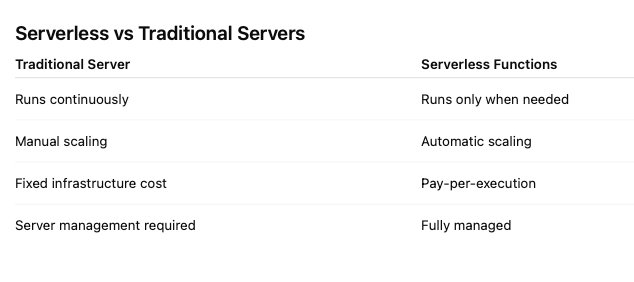
Serverless vs Traditional Servers
When Serverless Might Not Be Ideal
Although powerful, serverless isn’t perfect for every scenario.
It may not be ideal for:
- Long-running background jobs
- Heavy computation workloads
- Real-time WebSocket applications
- Persistent in-memory state applications
In such cases, a dedicated backend server or containerized setup might be better.
Best Practices for Using Vercel Serverless Functions
- Keep functions lightweight and focused
- Avoid heavy dependencies
- Use environment variables for secrets
- Connect to databases efficiently (reuse connections where possible)
- Monitor execution time and logs
Conclusion
Vercel Serverless Functions represent the future of backend development — simple, scalable, and developer-friendly.
For startups, solo developers, and fast-moving product teams, they remove infrastructure complexity and allow you to focus entirely on building features.
If you’re already deploying on Vercel, integrating serverless functions is a natural next step toward creating powerful, full-stack applications.