The Architecture of the Rat Race: Why Modern Success is a Golden Cage
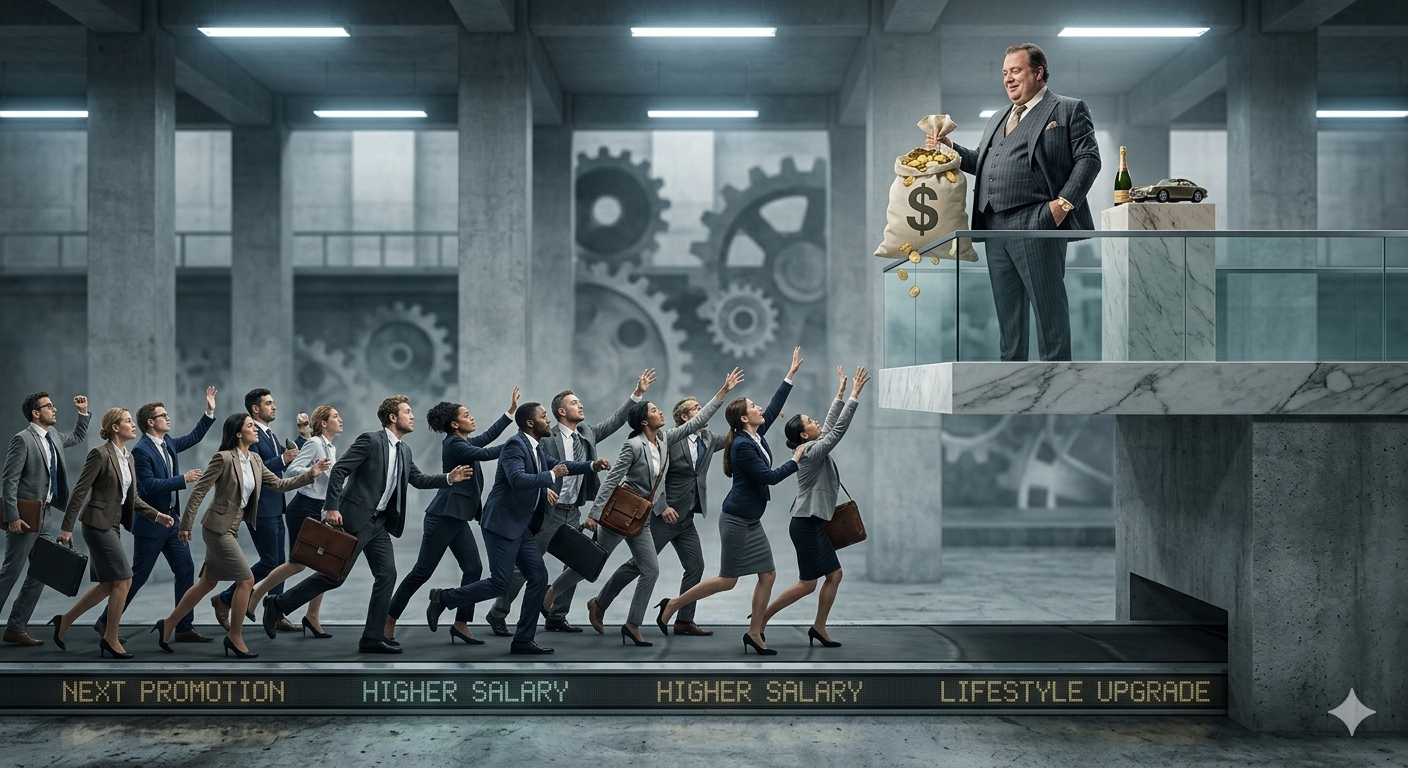
The tragedy of the "Rat Race" isn't just the effort involved; it is the design of the track itself. Most professionals believe they are running toward a finish line of "security," but the architecture of the modern economy is built to keep the runners moving indefinitely.

In the 2001 film Rat Race, a group of strangers are thrown into a chaotic competition to reach a hidden fortune. They sabotage each other, make reckless decisions, and race desperately toward the prize (a cash sum of $2,000,000). While the film is played for comedy, the metaphor is surprisingly accurate. Much of modern professional life resembles a quieter, more polite version of the same race; millions of people competing for higher salaries, bigger homes, and more status, yet rarely moving closer to true financial autonomy.
The tragedy of the "Rat Race" isn't just the effort involved; it is the design of the track itself. Most professionals believe they are running toward a finish line of "security," but the architecture of the modern economy is built to keep the runners moving indefinitely. To escape, one must stop looking for a faster pair of shoes and start looking for the exit.
1. Defining the Race: Income Chasing vs. Asset Ownership
Most people define the Rat Race as "working a job you hate." In reality, the definition is much more mechanical. The Rat Race is a state of Active Income Dependency. It is the condition where your survival is 100% tied to your continued labor.
The Treadmill of High Earnings
There is a common misconception that a high salary equals an escape from the race. However, a surgeon earning $500,000 a year can be just as trapped as a clerk earning $50,000. If the surgeon’s expenses, debt, and lifestyle require that $500,000 to function, they cannot stop running. They have simply traded a wooden treadmill for one made of gold.
The core of the race is Income Chasing without Asset Ownership. Participants focus entirely on the "Flow" (the paycheck) while ignoring the "Stock" (the assets). Because income is taxed at the highest rates and disappears the moment you stop working, relying on it as your sole source of security is a structural flaw in your financial architecture. Income disappears when you stop working. Assets continue working when you don’t.
2. Why We Stay: The Psychology of the Cage
If the race is so exhausting, why do so few people leave? The architecture of the Rat Race is reinforced by four psychological pillars that make the cage feel comfortable or at least necessary.
Tyler Durden in Fight Club, played by Brad Pitt, said it best:
“We buy things we don’t need to impress people we don’t care about.”
That’s not just philosophy, but the operating system of the rat race.
Lifestyle Inflation (The Moving Finish Line)
As soon as a professional receives a raise, they typically "upgrade" their life. They buy a larger home, a newer car, or more expensive vacations. This is Lifestyle Inflation. It ensures that no matter how much more you earn, the "margin" (the money left over) stays the same. By increasing your cost of living alongside your income, you move the finish line further away every time you get closer to it.
Debt as a "Future-Tax"
Debt is the ultimate anchor of the Rat Race. When you take on high-interest consumer debt or a massive mortgage that stretches your limits, you are effectively selling your future labor. You are no longer working for yourself; you are working for the bank. This creates a "forced participation" in the race. You cannot quit because you owe the system for the lifestyle you’ve already consumed.
Status Competition
Humans are social creatures, and we often measure our success by comparing ourselves to our peers. This leads to Status Competition; the need to own what others own to signal that we are "winning." The problem is that status is a zero-sum game. There is always someone with a bigger house or a newer watch. When you play the status game, you are letting society design your race.
Job Identity
For many, the race becomes their identity. When someone asks "Who are you?", most people answer with their job title. This creates a psychological barrier to escape. People fear leaving the race because they don't know who they would be without the title, the office, and the professional "aura" that comes with their position.
3. The Economic Design: How the System Reinforces the Race
The Rat Race isn't just a personal choice; it is reinforced by the way the modern economy is structured. From tax codes to consumer marketing, the environment is designed to reward spending and penalize idle capital.
The Tax Trap
In almost every modern economy, earned income (your salary) is taxed at a significantly higher rate than passive income (dividends, capital gains, or rental income). When you are in the Rat Race, you are working in the most "expensive" way possible. You are giving a large percentage of your time to the government before you even see a penny. Escaping the race requires moving your income from the "Earned" column to the "Asset" column, where taxes are lower and growth is compounded.
The Consumption Engine
Our economy is built on consumption. Every advertisement you see is a "nudge" to stay in the race. Companies spend billions of dollars to convince you that your current life is inadequate and that the solution is a purchase. This creates a cycle where you work to buy things, and then have to work more to maintain those things. The system thrives when you are a consumer; it is indifferent to whether you are free.
4. The Escape: Engineering Your Autonomy
Escaping the Rat Race does not mean "quitting work" or moving to a desert island. It means changing the source of your survival. The goal is to move from a Labor-Based Economy to an Asset-Based Economy.
The Three-Step Exit Strategy
I. Income to Assets: Instead of using your paycheck to buy "Liabilities" (things that take money out of your pocket), you use it to buy "Assets" (things that put money into your pocket). This includes stocks, real estate, or automated businesses.
II. The "Internal Tax": You must treat your investments as a non-negotiable expense. You pay yourself first, before you pay the landlord, the car dealership, or the grocery store. This creates the "fuel" for your escape.
III. The Freedom Number: You reach the exit when the cash flow from your assets covers your basic living expenses. When asset generated cash flow is greater than or equal to your living expenses.
At this point, your work becomes a choice. You can still choose to be a lawyer, a designer, or an engineer, but you are no longer doing it because you must. You are doing it because you want to.
Conclusion: The Race is Optional
In the film Rat Race, the characters eventually realize that the chase itself was a game designed by someone else for their own entertainment. The same is true for the modern professional. The rat race continues not because escape is impossible, but because most participants never realize the race itself is optional. We are taught to climb the ladder, but we are rarely taught to check what the ladder is leaning against. True success is not winning the race against your peers; it is removing yourself from the track entirely. Stop running for the prize that someone else placed at the end of the hall. Start building the architecture of your own independence.
WEALTH IS ENGINEERED. NOT EARNED.