Highest Mountains of the World: Towers of Ice and Stone


Mountains are among the most magnificent natural formations on Earth. They represent strength, endurance, serenity, and the sublime beauty bestowed by nature. In the global context, mountains are not merely geographical features; they are symbols of faith, courage, perseverance, and natural balance. For many people, mountains are sacred spaces, while for others they are ultimate challenges that test physical and mental limits.
Mountains have been interpreted differently by different cultures and individuals. Some see them as sacred abodes of gods, others as symbols of personal conquest, and yet others as vital ecological zones. Despite these varied interpretations, one universal truth remains: mountains are not ordinary landscapes but extraordinary natural entities that demand respect.
Globally, areas above 8,000 meters are considered extreme zones where human habitation is nearly impossible. These regions are characterized by harsh climates, low oxygen levels, and fragile ecosystems. Ordinary human life cannot be sustained there for long periods.
This article focuses on the highest mountains of the world, particularly those that lie within Nepal. Of the fourteen mountains in the world that rise above 8,000 meters, eight are located in Nepal. Among these, five mountains lie entirely or partially within Nepal’s Koshi Province.
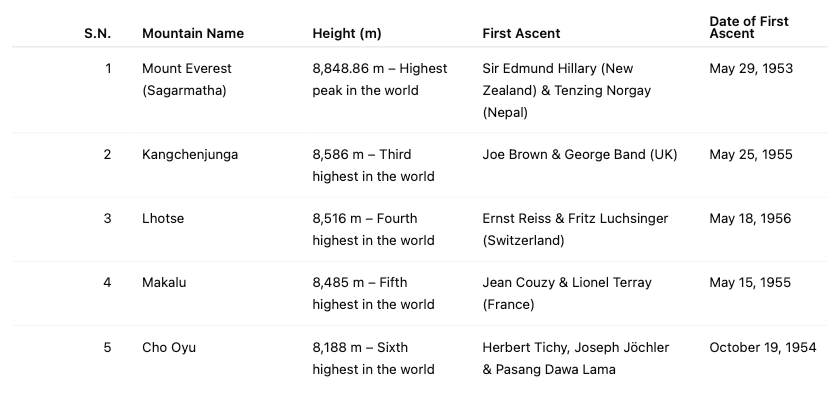
1. Mount Everest (Sagarmatha) – The World’s Highest Peak
Mount Everest, known as Sagarmatha in Nepal and Chomolungma in Tibet, is the highest mountain in the world at 8,848.86 meters. Nepal is internationally recognized as the “Land of Sagarmatha” because of this iconic peak.
Mount Everest attracts climbers from all over the world. There are two main routes to the summit: one from the Nepal (south) side and the other from the Tibet (north) side. The Nepal route passes through the challenging Khumbu Icefall, one of the most dangerous sections of the climb, requiring climbers to cross massive crevasses using ladders and ropes.
The first successful ascent was made on May 29, 1953, by Sir Edmund Hillary of New Zealand and Tenzing Norgay Sherpa of Nepal, creating world history. As of 2024, more than 8,000 climbers have successfully summited Everest.
Nepali climbers hold numerous records on Everest. Kami Rita Sherpa has climbed Everest 30 times, setting a world record, while Lhakpa Sherpa holds the record among women with 9 successful ascents. Among foreign climbers, Kentun Kul (UK) has summited Everest 14 times.
Despite its glory, Everest is extremely dangerous. Approximately 300 climbers have lost their lives during ascent attempts, and around 200 bodies are believed to remain on the mountain due to the difficulty of recovery.
From cultural and religious perspectives, Everest holds deep significance. Nepalis regard it as the “Head of the World,” Tibetans worship it as Chomolungma, the Mother Goddess of the Earth, while Europeans poetically call it the “Forehead of the Sky.”
2. Kangchenjunga – The Third Highest Mountain in the World
Kangchenjunga, standing at 8,586 meters, is the third highest mountain in the world and lies in Nepal’s Taplejung District of Koshi Province, bordering India’s Sikkim region.
Kangchenjunga is considered one of the most difficult and dangerous mountains to climb due to its remoteness and harsh conditions. It is located within the Kangchenjunga Conservation Area, known for its stunning natural beauty and rich biodiversity.
The region is home to rare wildlife such as red pandas, snow leopards, musk deer, and various rare plants and medicinal herbs. In November alone, recent surveys recorded seven snow leopards in the area.
The mountain was first successfully climbed on May 25, 1955, by Joe Brown and George Band from the United Kingdom. Culturally, Kangchenjunga is revered as a deity by the Limbu, Rai, and Sherpa communities of eastern Nepal and Sikkim. Out of respect, climbers traditionally stop short of the true summit, leaving it untouched.
3. Lhotse – The Fourth Highest Mountain in the World
Lhotse, rising to 8,516 meters, is the fourth highest mountain in the world and lies in Nepal’s Koshi Province, adjacent to Mount Everest along the Nepal–Tibet border.
Climbers attempting Lhotse often share the same route as Everest up to Camp III before diverging. Lhotse is renowned for its steep, icy rock faces, making it one of the most technically challenging climbs.
Rock climbers often regard Lhotse as more demanding than Everest. The ascent requires navigating razor-sharp ridges and vertical ice walls, making it extremely hazardous.
The first successful ascent was achieved on May 18, 1956, by Ernst Reiss and Fritz Luchsinger of Switzerland.
4. Makalu – The Fifth Highest Mountain in the World
Makalu, standing at 8,485 meters, lies in eastern Nepal’s Sankhuwasabha District, near the Nepal–Tibet border. It is widely recognized for its distinctive pyramid-shaped structure.
Makalu is considered one of the most difficult mountains to climb due to its steep ridges and isolation. It lies within the Makalu-Barun National Park, one of Nepal’s most pristine natural regions.
The area is rich in biodiversity, including red pandas, snow leopards, Himalayan black bears, and over 400 species of butterflies found only in Nepal.
Makalu was first climbed on May 15, 1955, by French climbers Jean Couzy and Lionel Terray.
5. Cho Oyu – The Sixth Highest Mountain in the World
Cho Oyu, at 8,188 meters, is the sixth highest mountain in the world and Nepal’s fifth highest peak. It lies close to Everest and is considered one of the more accessible 8,000-meter peaks for climbers.
Tibetans describe Cho Oyu as a “Turquoise Goddess”, as the mountain reflects a bluish-green hue when sunlight hits its icy slopes. It is also revered by local Nepali communities as a sacred mountain.
The first successful ascent was made on October 19, 1954, by Austrian climbers Herbert Tichy and Joseph Jöchler, along with Nepali Sherpa Pasang Dawa Lama.
Conclusion
Mountains are not merely towering masses of rock and ice; they are symbols of natural power, cultural heritage, spiritual belief, and human perseverance. Nepal, home to the world’s highest peaks, plays a central role in global mountaineering history and ecological preservation. These mountains continue to inspire awe, respect, and humility in all who encounter them.