What is work breakdown structure
Creating a Work Breakdown Structure involves several clear steps. The first step is defining the project scope and objectives. Without a clear understanding of what the project aims to achieve, it is impossible to create an effective WBS.


A Work Breakdown Structure, commonly known as WBS, is a project management tool used to divide a project into smaller, more manageable components so that planning, execution, and control become more organized and effective. It is a hierarchical decomposition of the total scope of work required to complete a project, breaking it down into deliverables and sub-deliverables until the work becomes simple enough to estimate, assign, and monitor.
Instead of focusing on timelines like a Gantt chart, a Work Breakdown Structure focuses on what needs to be delivered. It ensures that every part of the project is clearly defined and that no essential task is overlooked. The concept is widely used in industries such as construction, software development, engineering, event management, and research, where complex projects require structured organization.

The primary purpose of a Work Breakdown Structure is to clarify project scope. Many projects fail because of unclear expectations, missing tasks, or poorly defined deliverables. A WBS prevents these problems by organizing the entire project into a tree-like structure with multiple levels.
At the top level is the overall project objective. Below it are major deliverables or phases, and beneath each of those are smaller components, eventually reaching work packages. A work package is the lowest level of the WBS and represents a task that can be assigned to a team or individual, budgeted, and scheduled. By breaking the project into these smaller units, managers can estimate costs and durations more accurately and allocate resources effectively.
One of the key principles of a Work Breakdown Structure is the “100 percent rule.” This rule states that the WBS must include 100 percent of the work defined by the project scope and capture all deliverables, including internal, external, and interim outputs. Nothing outside the defined scope should be included, and nothing within the scope should be omitted.
This principle ensures completeness and prevents scope creep, which occurs when additional tasks are added without proper approval or adjustment of time and budget. By adhering to this rule, project managers maintain control and alignment with project objectives.
A Work Breakdown Structure is deliverable-oriented rather than activity-oriented. This means it focuses on the results or outputs that must be achieved, not just the actions required. For example, in a website development project, a WBS might include major deliverables such as design, development, testing, and deployment. Under design, there might be sub-deliverables like user interface layout and graphic assets.
Each of these can be further broken down into specific work packages. This structure ensures that the project team understands exactly what must be produced at each stage. Activities and schedules can then be developed based on these defined deliverables.
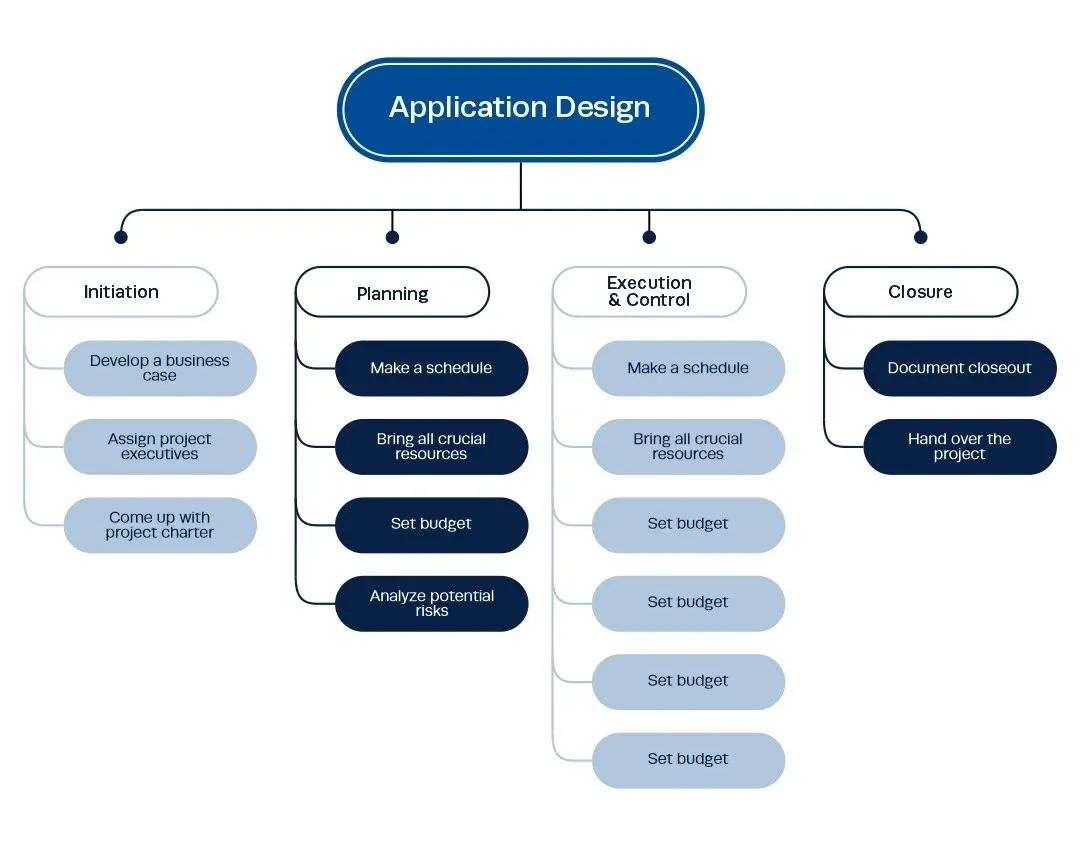
Creating a Work Breakdown Structure involves several clear steps. The first step is defining the project scope and objectives. Without a clear understanding of what the project aims to achieve, it is impossible to create an effective WBS. Once the scope is confirmed, the next step is identifying the major deliverables or phases of the project.
These form the second level of the hierarchy. After that, each major deliverable is broken down into smaller components. This process continues until the tasks reach a level where they are manageable, measurable, and assignable. The level of detail depends on the size and complexity of the project. Smaller projects may require only two or three levels, while large projects may require many more.
There are different formats in which a Work Breakdown Structure can be presented. The most common is a graphical tree structure that visually shows the hierarchy from top to bottom. Another format is an outline view, which lists levels using numbers and indentation, such as 1.0, 1.1, 1.1.1, and so on.
This numbering system is helpful for tracking and referencing specific components of the project. Some teams also use tabular formats that combine WBS elements with descriptions, responsible persons, and estimated costs. Regardless of the format used, the goal remains the same: to create a clear and comprehensive breakdown of the project’s scope.

The benefits of a Work Breakdown Structure are significant. It improves planning by ensuring that all deliverables are identified before scheduling begins. It enhances communication because stakeholders can easily see how the project is organized. It also supports budgeting, as costs can be estimated at the work package level and then aggregated upward.
Risk management becomes easier because potential problem areas can be identified within specific components of the structure. Furthermore, performance measurement becomes more precise since progress can be tracked against defined deliverables rather than vague tasks.
In practical project management, the Work Breakdown Structure often serves as the foundation for other planning tools. Once the WBS is complete, it can be used to develop schedules, assign responsibilities, estimate budgets, and create timelines.
For example, after defining work packages, a project manager can determine the sequence of tasks and represent them visually in a Gantt chart. In this way, the WBS provides the structural backbone of the project, while scheduling tools show the timing of activities. Without a well-prepared WBS, other planning tools may lack accuracy and clarity.
In conclusion, a Work Breakdown Structure is an essential project management technique that organizes complex projects into smaller, manageable components. By focusing on deliverables and following the hierarchical decomposition process, it ensures clarity, completeness, and control over project scope. Whether used in small assignments or large-scale initiatives, the WBS enhances planning accuracy, resource allocation, budgeting, and communication.
Understanding and applying the principles of a Work Breakdown Structure significantly increases the likelihood of project success by providing a clear roadmap of what must be accomplished and how the work is structured from start to finish.